“Nature is not a place we visit. It’s the operating system we forgot we were running on.”
🌍 A New Category for a New Era
During the recent London Climate Action Week, we had the privilege of co-hosting a roundtable with HSBC to explore a critical emerging category: NatureTech — the convergence of technology and ecological systems to power a more resilient, regenerative economy.
We did this in the context of the global food system - an industry entirely reliant on the natural world and the roundtable convened global consumer foods corporate leaders, including representatives from Nestlé, Unilever, Diageo, Tesco, and Haleon, paired with the voices of cutting-edge startups such as Meridia (RGVC portfolio company), NatureMetrics, Zulu Ecosystems and Great Yellow, fellow mission-aligned investors from Just Climate, Grosvenor, Superorganism, and great friends and co-conspirators at Elemental Impact and GoogleX.
With this braintrust assembled, at our roundtable, we asked ourselves:
How do we value and regenerate nature in the food system—not just as a resource, but as infrastructure, intelligence, and commercial opportunity?
TLDR: We came away with a powerful shared conviction: the restoration of nature is not only a planetary imperative — it’s one of the biggest opportunities of the 21st century.
Some market context: NatureTech is a category in motion. According to Nature4Climate, NatureTech is already experiencing foundational growth of more than 5x in the last 5 years, reaching $3 billion in financing activities. More than 500 start-up companies are now globally active in the space, offering solutions from biodiversity monitoring and carbon quantification to regenerative land management and supply chain traceability.
🌱 The Investment Thesis: Decoding Nature
Regeneration.VC sees NatureTech as one of the most powerful frontiers for climate innovation. It represents a shift from thinking of nature as a passive victim of industry to understanding it as a living, intelligent system — one we can learn from, partner with, and regenerate.
We believe this investment curve is just beginning. What’s driving it forward? Three converging shifts:
- Technological tailwinds. Falling costs in AI compute, sensors, and sequencing are enabling more scalable and affordable ecological intelligence. More to follow in this piece.
- Regulatory pressure. Policies like the EU’s CSRD and Taskforce on Nature-related Financial Disclosures (TNFD) are pushing companies to act on planetary impacts —moving beyond the carbon tunnel.
- Corporate demand. Major brands need nature-positive supply chains to secure long-term continuity, mitigate biodiversity risk, and maintain social license.
We are entering a moment in history where, for the first time, we have the tools to understand the complexity of natural systems at scale, and there is an increasing willingness from stakeholders to use capital and innovation as a force for good to protect our natural systems.
This isn’t science fiction. It’s the emerging infrastructure of what we call SuperNature — a world where technology and ecology are no longer in opposition, but in harmony.
🤖 Ecological intelligence
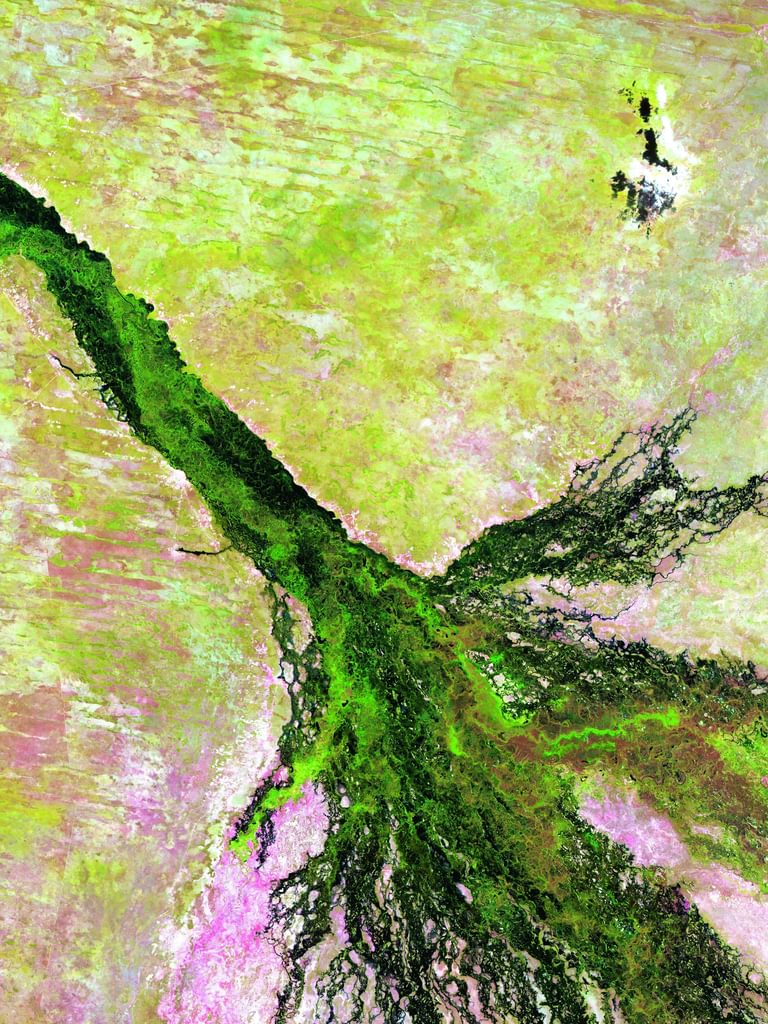
The ability to measure ecosystems in real-time is undergoing a Cambrian explosion. Environmental DNA (eDNA), satellite imaging, and new remote sensing technologies are making nature visible and therefore, actionable at unprecedented spatial and temporal resolution.
Coupled with advancements in artificial intelligence, there is huge potential to transform how we engage with nature. Once, we observed ecosystems with our senses and our stories. Today, we are building models that can decode everything from soil microbiomes to migratory patterns to genetic blueprints. This is enabling a new form of relationship: one in which humans don’t dominate nature, but listen to it, model it, and collaborate with it. Think AGI for the natural world.
Take the pioneering work of NatureMetrics and one of “OG” NatureTech start-ups participating at our roundtable, which can analyze a single water sample to reveal the DNA traces of thousands of species, allowing us to understand biodiversity with more precision than ever before. These technologies are transforming environmental data into real-time intelligence.
But intelligence is only as useful as the actions it enables. Our core thesis asks: How can the products we consume every day create less destructive impacts on nature? And this flows right down the supply chain to the natural world. That’s where new capabilities in robotics, remote and edge-compute-enabled sensing, and distributed networks create opportunities for the maintenance and management of natural ecosystems in increasingly remote and harsh conditions, driving operating leverage into those responsible for resource management.
And then, in the context of the building blocks of our post-fossil economy, NatureTech in our minds encompasses a new generation of bio-industrial tools building new atoms, materials, inputs, and products from the molecular level up with generative bio-design that mimics, and often outperforms, nature’s original code. RGVC portfolio companies Epoch Biodesign are using enzymes to break down waste and regenerate ecosystems, and Colorifix, Cellugy, and Notpla are reimagining biomaterials with nature as the inspiration.
As this whole technology stack matures, we are beginning to see nature not just as a resource or a risk, but as infrastructure. Forests, wetlands, fungi, and even microbial communities are all performing critical functions — regulating carbon, producing oxygen, purifying water, buffering extreme weather — with a level of intelligence that no human-designed system has ever matched. What’s changed is that now we can see it, measure it, and, in some cases, even build with it.
One major consumer corporation captured the shift: “We innovate in nature and for nature.” They are not only working within existing supply chains, they are helping build entirely new ones, partnering with early-stage startups to deliver this vision.

Unblocking Capital Flows
But if we are serious about regenerating the natural systems that underpin our economy, we need new financial models. One of the most consistent messages we heard in the roundtable was the urgent need for “transition finance” — capital that supports farmers, land stewards, and innovators in the messy, uncertain middle between business-as-usual and regenerative systems.
We see an opportunity to invest in platforms that turn ecological data into operational signals for commercial operations - for procurement, insurance, risk, crediting, and financing. Case in point, our portfolio company Meridia empowers global commodity supply chains with granular and defensible sourcing insights from land use.
Today, most capital waits until the outcomes are proven. But nature doesn’t operate on quarterly returns. The companies building this new economy, whether they’re restoring soil, measuring biodiversity, or engineering climate-resilient crops, need buyers and investors willing to share risk and reward. Companies like Zulu Ecosystems and and Great Yellow are building the rails for new asset classes that make ecosystem services measurable and investable.
At Regeneration.VC, we believe capital must evolve to match the complexity and timelines of natural systems. That means embracing risk-tolerant finance, investing in enabling infrastructure, and working with corporates to create pull-through demand for NatureTech innovation.
And it comes back to the data, which plays a catalytic role here too. High-quality, real-time ecological data can make previously invisible services, like carbon drawdown, legible to markets. This opens the door to nature-based assets that are not just tradable, but also insurable, bankable, and investable. In the coming decade, we believe nature’s services will become a core part of corporate balance sheets, sovereign risk models, and, importantly, in for our “Insetting” investment thesis - consumer value chains. But with great data comes, great responsibility, as one participant put it: “NatureTech can’t scale unless land stewards win.” We agree and see the need for new shared revenue models, marketplaces, and new data monetisation models. Nature-data has a value for the commons, so creating data silos will slow us down.
Why This Matters Now
The food system is one of the most immediate and urgent domains where NatureTech must scale. It is where ecological degradation is most acute, and where regenerative approaches are already delivering clear results. Our corporate partners shared a range of success stories, driving real change into their supply chain with nature as a key motivator. But food is only the beginning. The underlying technologies and principles of NatureTech apply across sectors, from soft commodities to infrastructure and insurance to fashion, biomanufacturing, and consumer goods.
So we believe we are at an inflection point. Just as the 20th century was defined by the harnessing of fossil fuels and mechanization, the 21st will be defined by our ability to work with the intelligence of the natural world — to decode it, respect it, and design alongside it.
This is not about returning to a pre-industrial state. It’s about moving forward — toward a world where every factory, farm, and city is embedded within a regenerative system. A world where abundance is not extracted from nature, but flows in circular, intelligent loops that replenish ecosystems and communities alike. As our friends at Superorganism put it so succinctly, “We want to back companies that improve life with more nature — not less.”

🌳 Fast Forward to 2100: A Vision of SuperNature
What’s unfolding is a vision not just of sustainability, but of something more profound.
Imagine a world where:
- Cities breathe like living forests — filtering air, cycling water, and sequestering carbon.
- Oceans pulse with abundant life — sustained by intelligent marine restoration networks tied to quantified ecosystem benefits.
- Agriculture regenerates soil as it feeds people, using AI-guided, biologically-optimized systems.
- Robotics and fungi collaborate to restore degraded land while growing next-gen biomaterials.
At Regeneration.VC, we invest in early-stage companies building this future. Companies that combine artificial intelligence, natural sciences, and ecological insight to power a new kind of economy — one where humans and nature thrive as co-creators.
This is SuperNature: a world where intelligence nurtures the planet rather than exploiting it. Where energy, food, and materials flow in closed loops, continuously renewing themselves. Where human progress and planetary health are aligned.
We believe this is not only possible — it’s inevitable. The only question is how fast we get there, and who builds the infrastructure along the way.
If you’re building tools to restore ecosystems, redesign materials, or turn nature’s intelligence into market-shaping solutions — we want to hear from you.



Disclaimer: This article is intended for educational purposes only. Certain information contained herein has been obtained from other parties. While such sources are believed to be reliable, neither the Fund, the General Partner, the Management Company, nor their respective affiliates assume any responsibility for the accuracy or completeness of such information. The ecosystem mapping depicts a broad and non-exhaustive sample of companies at various business stages. Regeneration.VC holds an investment interest in some of these companies. The contents of this work should in no way be construed as investment recommendation guidance from Regeneration.VC. The information set forth does not purport to be complete and no obligation to update or otherwise revise such information is being assumed.