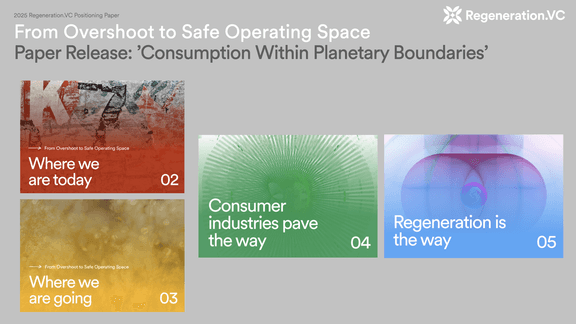
“Consumption Within Planetary Boundaries” offers Regeneration.VC’s comprehensive thesis on how Consumer ClimateTech venture capital accelerates the shift to an economy designed to thrive.
The Challenge: Material and Resource Use
For five decades, rising consumption has meant greater material extraction, use, and waste. Efficiency gains helped, but not enough. The result: humanity is exceeding seven of nine Earth-system thresholds, with consumer supply chains contributing significantly to pressures on climate, oceans, biodiversity, water, and toxicity. Regeneration.VC’s mandate is to address both efficiency and volume, enabling the economy to operate within the safe operating space.
A Deployable Thesis Informed by Systems Thinking
Guided by Oxford economist Cameron Hepburn’s “Sensitive Intervention Points,” Regeneration.VC backs founders catalyzing outsized change along two complementary strategies where targeted, well-placed innovation interventions can trigger large, durable change across complex global supply chains. These are:
Kicks improve material metabolism: design, processes, and recovery that cut loss and return materials at value.
Shifts reduce and upgrade the quality of material intake: business models and technologies that deliver equal or better outcomes with far fewer virgin inputs.
Corporates as Critical System Change-Makers
Downstream brands and retailers hold decisive leverage to set standards, fund adoption, and propagate solutions across thousands of suppliers. When they adopt upstream technologies that win on cost, performance, and speed, change scales and sticks. Regeneration.VC invests to help founders meet that bar and integrate quickly.
Portfolio as Proof
Greyparrot (AI waste intelligence) connects packaging design to real recyclability, Matter (microfiber capture) prevents pollution at both household and mill scales, Colorifix (biological dyes) and Nature Coatings (biobased pigments) embed nature’s logic into materials we use everyday, SmarterSorting gives retailers product intelligence for safer and higher-value end-of-life, Epoch Biodesign turns hard-to-recycle plastics back into high-quality feedstock, Cruz Foam replaces polystyrene with a compostable price-and-performance competitive alternative.
Read our positioning paper here: https://drive.google.com/file/d/139YAKV4j-GrXzPQ6IxXTumbqd8zf5Qzz/view
Media contact: [email protected]