Seven of nine planetary boundaries have now been transgressed. Consumer industries drive more than half of that overshoot, yet the circular transition remains structurally underfunded.
Our 2025 Impact Report is out. It is the fourth annual account of our work, covering Fund 1, Fund 2 and the Sub-Ocean Fund for the 2025 financial year. It reports results across our organisation, portfolio companies and wider ecosystem, and shows our direction of travel and our contribution to systemic change. We share our learnings, our reflections and our portfolio's progress openly, because the transition we are working towards needs collaboration across actors and systems to get there.
Systemic investing in practice
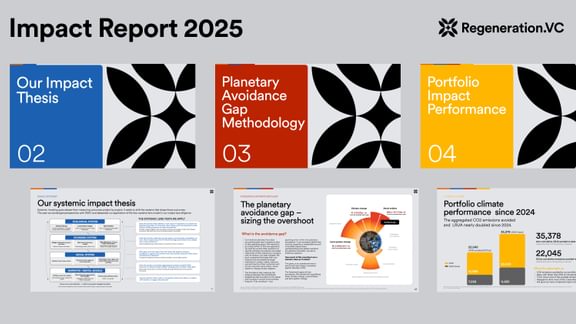
This year we share more of our systemic investing thesis. The report sets out how we analyse root causes and leverage points, draw system boundaries around the circular transformation of consumer value chains, and apply the Sensitive Intervention Points framework and the four systems model: ecological, economic, social, and narrative & mental models. No single company moves a system alone, so we work across the ecosystem with founders, corporate partners, co-investors and industry working groups.
The planetary avoidance gap methodology
Founders show solutions that beat the linear status quo. We want to help them go further, funding solutions ambitious enough to bring consumer value chains back inside the planet's safe operating space. With Circle Economy, we developed the Planetary Avoidance Gap methodology. It sizes the overshoot the world must avoid each year, such as 47.2 gigatons of carbon dioxide equivalent for climate change, and scales it down to a sector and company threshold. This is an early pilot in our pre-investment due diligence. We share the thresholds and assumptions openly to start the conversation and invite feedback.
Portfolio impact
In 2025 our portfolio avoided 23,423 tons of virgin material through Linear Resource Use Avoided, up 96% year on year, and 14,986 tons of CO2e emissions, up 112%. Cumulatively since 2024, the portfolio has avoided 35,378 tons of LRUA and 22,045 tons of CO2e.