From Fragmentation to Flow: The ReCommerce 2.0 Thesis
At Regeneration.VC, our mandate is straightforward: fund technology companies that can re-wire our consumption patterns and help us all achieve a better balance with our planet. The circular economy sits at the heart of that thesis — and ReCommerce (secondary markets) has long been one of its most compelling proof points of how industry growth and sustainability can go hand in hand.
From our vantage point as early-stage investors in this space over the last decade, the 1.0 era had its winners. Vinted is no longer a startup — it's a European giant, and BackMarket too. Depop’s acquisition by Etsy provided further validation of the value of active network effects. And whilst you could be forgiven for thinking this was now a category without much room to run, the tectonic platform shift we are witnessing with the AI-supercycle, seems to have been stimulating a lot more start-up activity which has been hard to ignore.
So on a warm Spring evening in Berlin, we thought it would be a good idea to convene a room of founders, investors, and operators and some of Europe’s leading consumer brands to ask a specific question: what could ReCommerce 2.0 look like?
We were delighted to do so alongside our friends at Vinted Ventures, Zalando, and H&M Group Ventures, who also gratefully hosted us at their fabulous offices — a fitting venue, given that partnering with the world's largest consumer companies is central to how we work.

The Market Shift
The numbers are well known to anyone operating in this space. 90% of Gen Z consumers have purchased secondhand apparel, and for the majority it's now the default. Two-thirds of all consumers factor resale value into apparel purchases. Three-quarters of retailers and brands are implementing circular models. Secondhand apparel is growing at 2x the rate of the overall market — on track to exceed $300bn by the end of the decade.
In a world of tariffs, supply chain disruption, and persistent inflation, circular commerce is increasingly offering a more strategic advantage. And the dominant driver has never been sustainability alone - it has always been about value. Affordability, convenience, trust and the search for unique style are what brings most consumers in. Once they start buying, they often start selling too.
But despite that stellar growth, the space has remained characterised — at both the brand and consumer level — by complexity, inconsistent quality control, and persistent logistics bottlenecks.
We saw this first-hand through our US portfolio company Arrive ReCommerce, which unfortunately closed last year despite significant enterprise partners and multi-million dollar revenues. The demand was there but the unit economics at scale were always pressured.
That failure sharpened our thinking considerably. ReCommerce 1.0 has been riddled with frictions, asking people to identify items, judge condition, arrange shipping and / or pay a lot of it, set selling prices, write listings, answer questions, deal with fraud / counterfeits, resolve disputes, and decide what to do with returns.
While the linear fashion supply chain has become extraordinarily efficient over decades of investment and optimisation, the reverse supply chain remains manual, fragmented, and expensive. That asymmetry is the core problem — and the core opportunity.

The New Market Evidence
The clearest signal that something structural is shifting is where early capital is going — and how quickly it's moving.
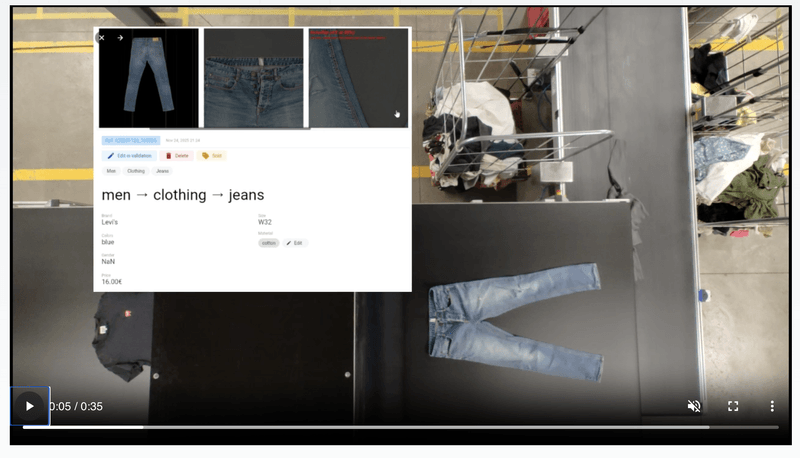
At the operational efficiency layer, the core thesis is that AI can collapse the per-item cost of getting goods back into circulation. Sellpy (who were a panel participant at our Berlin event), operating across 10M items in 24 markets, has rebuilt its flow so AI handles item description from photos first, with humans stepping in only for logistics exceptions. EcomID (another featured panelist) is attacking the €850bn returns problem — 70% of which is sizing — through personalised fit data and dynamic return fees, building what amounts to a shopping passport to prevent returns before they happen. Specialised data processing and data quality is a clear friction for all parts of the ReCommerce value chain. Network360 (another panelist) who handle 40M garments per year for brand partners have invested heavily in data ingestion and cleaning. Bencha has been quitely building the system that does the pricing — automatically, at scale, across hundreds of thousands of second-hand listings.
But on the logistics front, the next frontier is physical AI — robotics systems that can handle the variability, unpredictability, and sheer messiness of secondhand goods at scale. Unlike new inventory, pre-owned items arrive in inconsistent conditions, orientations, and packaging that defeats basic rule-based automation. The emerging generation of physically intelligent systems — trained on real-world handling data rather than fixed rules — is could change this so throughput that approaches the economics of new goods fulfilment. When that happens, the unit economics of mass-market ReCommerce change fundamentally. Trosort is attacking this problem directly.
At the supply and liquidity layer, the new bet is that scale requires professionalised infrastructure, not just consumer marketplaces. Fleek is building wholesale sourcing infrastructure for secondhand fashion — because structured supply is the prerequisite for volume. Bought (who also joined us in Berlin) is innovating through auto-generated listings via purchase history and growing user listings fast. And with over $50M to define a category of what they call “intentional commerce”, Croissant in the US is embedding guaranteed resale value at the moment of purchase — flipping the model entirely so that resale begins before the item is even bought, now with $50M+ GMV and 100,000 users already on the platform.
The brand-integrated resale category is where we see ongoing innovation through more structural approaches. Rather than resale sitting awkwardly beside brands, BrandBack and Faume are embedding it directly inside them and Treet builds out a white label solution for brands. The direction of travel is clear: brands want to own the secondhand relationship with their customers, not cede it to third-party platforms.
Finally, at the agentic consumer layer — perhaps the most nascent but most watched — two recent Y Combinator companies are sketching what a next-generation marketplace could look like. Rid lets users resell possessions via text message, removing the listing friction entirely. SellRaze has reached 200,000 users and is publishing 2,500 products a day within weeks of launch. Veliu is bringing further sophistication in a data-rich market-making with embedded demand signals focusing on reducing time to transact for users (starting in luxury and premium goods). For pure discovery, Beni and Faircado sit at the aggregation layer to shortwire secondhand discovery across platforms with new, well-funded entrants like Phia also aggregating primary and secondary offerings. With agentic webstores like Swap, integrating return management and surely coming for second hand markets too - the direction of travel is clear. Less browsing, more delegation, faster transactions — the interface to resale is disappearing into the background.
Taken together, these aren't isolated bets. They represent a coordinated attack on every friction point in ReCommerce 1.0.
Learnings from our discussion in Berlin
The conversations in Berlin revealed something important: there are still a lot of white spaces to fill.
On the demand side, brands are genuinely engaged. Resale programs are running, and the strategic case is understood. But there are still capability gaps. Physical automation in returns and resale processing still remains cumbersome. AI-generated listings can still suffer from inaccuracies that undermine consumer trust. Size and fit prediction from images remains an unsolved problem at scale. And fashion curation — the ability to identify what is actually on-trend versus merely available — still requires a human eye that AI hasn't convincingly replaced.
There is also a structural tension that brands are navigating: how to build a secondhand relationship with their own customers, rather than ceding that ground to third-party marketplaces. This has proved harder than primary commerce in practice. Consumer trust in AI-verified listings is growing, but the demand for curated, inspirational secondhand experiences — rather than purely transactional ones — is a white space that few have credibly addressed.
Quality curated supply is the other persistent constraint. Several brands noted that the binding limitation isn't consumer demand for secondhand — it's getting sufficient, well-graded inventory into the system efficiently enough to meet it. That points to a clear opportunity in the tooling and infrastructure layer: better intake, smarter routing, and faster time-to-listing.
Regulatory tailwinds are also beginning to matter. New legislation is forcing brands to adopt better data management and earlier decision-making around cross-border inventory movement, with meaningful penalties for non-compliance. Also, the Ecodesign for Sustainable Products Regulations and Digital Product Passports aim at making physical goods highly circular, climate-neutral, and energy-efficient. As policy frameworks tighten across Europe, the compliance and traceability layer of ReCommerce becomes more foundational.
Finally, there's a quieter but strategically important feedback loop emerging. Research from BCG points to over half of consumers discovering or purchasing a brand for the first time through secondhand. That means ReCommerce isn't purely downstream value recovery — it's upstream demand creation. Resale data feeds back into design, pricing, durability decisions, and primary market forecasting in ways that brands are only beginning to understand and act on.

Where we are excited
If ReCommerce 2.0 is going to accelerate, we are watching for a few signals.
On the supply side, operational intensity per item should fall materially. New systems will push humans into exception handling, not workflow execution. Sell-through velocity should improve — driven by pricing intelligence, not discounting. Trust metrics - dispute rates, return rates, fraud - should decline as AI-verified grading and listings raise the quality floor and more efficient physical authentication operations are improved by AI. And routing decisions should get sharper: the strongest platforms will get good at not forcing everything through resale, automatically diverting items to repair, wholesale, or recycling where that creates more value. And watch the physical layer. The first platforms to achieve near-automated intake, grading, and routing of returned and donated inventory — without proportional growth in headcount — will have cracked the cost structure. Physical AI could be this the final unlock, and we are watching it closely.
On the demand side, search, matching and discovery will continue to be a very competitiive battleground for new start-ups and encumbants alike.
Defensibility will also shift. The moat in ReCommerce 2.0 won't be brand recognition or marketplace liquidity alone. It will be proprietary data, deeply integrated workflows, and learning curves that compound as transaction volume scales. We think the winners may look less like marketplaces and more like operating systems for circular value chains.
ReCommerce 1.0 made secondhand acceptable. ReCommerce 2.0 — if the current wave of companies delivers on its early promise — makes it structurally inevitable.
If you are building in this space, we’d love to hear from you.

Disclaimer: This article is intended for educational purposes only. Certain information contained herein has been obtained from other parties. While such sources are believed to be reliable, neither the Fund, the General Partner, the Management Company, nor their respective affiliates assume any responsibility for the accuracy or completeness of such information. The ecosystem mapping depicts a broad and non-exhaustive sample of companies at various business stages. Regeneration.VC holds an investment interest in some of these companies. The contents of this work should in no way be construed as investment recommendation guidance from Regeneration.VC. The information set forth does not purport to be complete and no obligation to update or otherwise revise such information is being assumed.