Why Now?
Tackling climate change requires more than innovation – it requires impact at scale and successful moves from lab to market – fast. The IEA estimates that 35% of the emissions reductions needed by 2050 must come from technologies still in development. But turning lab discoveries into commercial solutions is notoriously hard: timelines are long, funding is risky, and policy frameworks are often unclear.
Europe is emerging as a powerhouse of climate innovation – over 900 early-stage climate tech startups raised €20 billion in 2023. Yet, there is a sobering reality: Deloitte estimated a $2 trillion private funding gap for next-generation climate technologies by 2030. Some of this money will come from Venture Capital, but money alone is not enough.
This poses a critical challenge: how do investors distinguish real climate solutions from well-marketed distractions? And how do we get these solutions market-ready – and scalable – fast enough to make a difference?
Raising the bar on early-stage impact
Many investors lack the tools to evaluate impact at the pre-seed stage. Existing frameworks (like SFDR or the EU Taxonomy) aren’t designed for early climate tech, and startups often don’t know what data to provide. The result? Promising innovations are overlooked – and many are still in the lab or struggling to cross the "valley of death" between early innovation and commercial success.
This article offers five essential questions to guide early-stage climate due diligence. Whether you are a founder or an investor, answering them helps ensure that climate capital flows where it can do the most good – from day one.
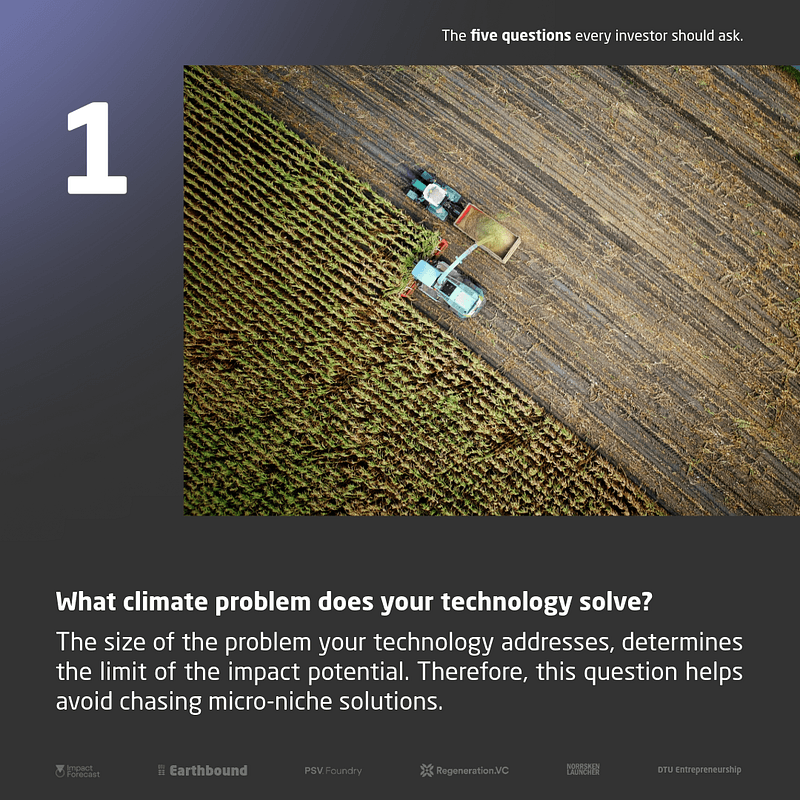
What Climate Problem Does Your Technology Solve?
The size of the problem your technology addresses determines the upper limit impact potential. For example:
- Energy, industry, buildings, and transport account for over 70% of global emissions.
- Cement, landfill, deforestation, and wastewater are smaller (each under 3%), but still vital.
It’s therefore a useful perspective to see that a solution that eliminates all GHG emissions of the entire global cement industry, does the same work for climate change mitigation as a zero-emission solution for road transport – applied to 25% of the market. The question also helps avoid chasing micro-niche solutions – like “eco pet treats” or “sustainable underwear” – with more limited potential. Ask: How big is the total GHG reduction opportunity, and what is the expected value of your impact? Look at the Solutions Library from Project Drawdown or Mission Innovation for inspiration.
How Does the Innovation Reduce GHG Emissions?
A credible pathway from technology to the GHG emission reduction it provides should be clear. This could involve:
- Improving resource efficiency (e.g., route optimisation to reduce transport emissions): Reductions typically originate in avoiding some resource usage through efficiency, like how route optimisation avoids transport, how insulation avoids heating and how solar energy avoids burning fossil fuel.
- Reducing resource footprint (e.g., green hydrogen): Reductions can originate in replacing resources with a less emissive alternative, as how green hydrogen and green ammonia have lower lifecycle emissions than fossil fuels and how a soy burger is less emissive than a beef burger.
- Decarbonising processes (e.g., carbon-binding concrete): The third important GHG reduction pathway is similar but applies to processes instead of resources, for example carbon-binding concrete, closed-loop farming, methane-mitigating animal feed and biochar applications all changes the chemistry in a process, so it emits less greenhouse gas.
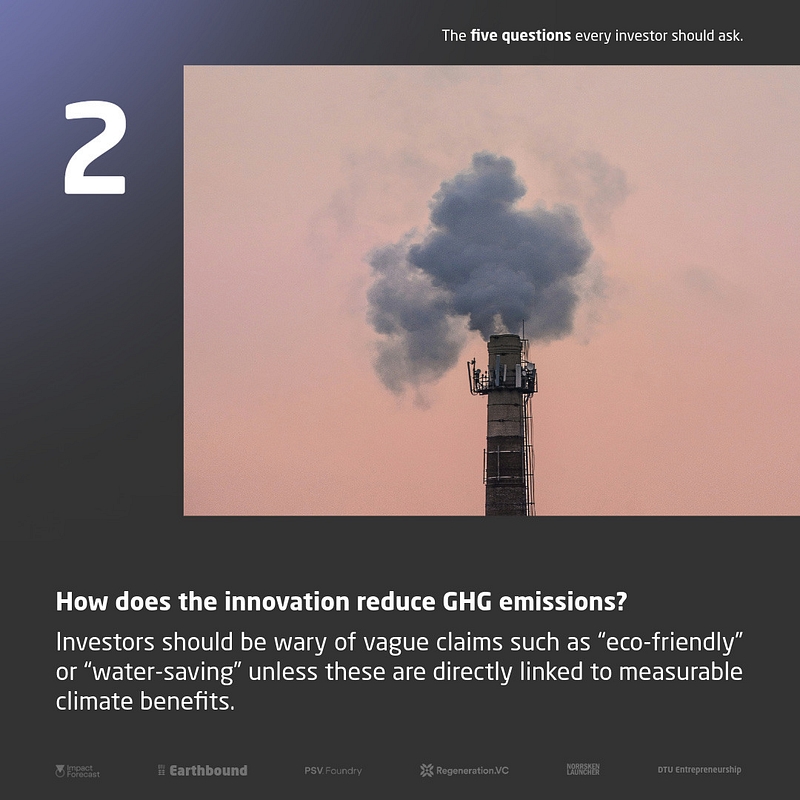
In all three examples however, investors should be wary of vague claims such as “eco-friendly” or “water-saving” unless these are directly linked to measurable climate benefits.
How Does the Innovation Generate Emissions?
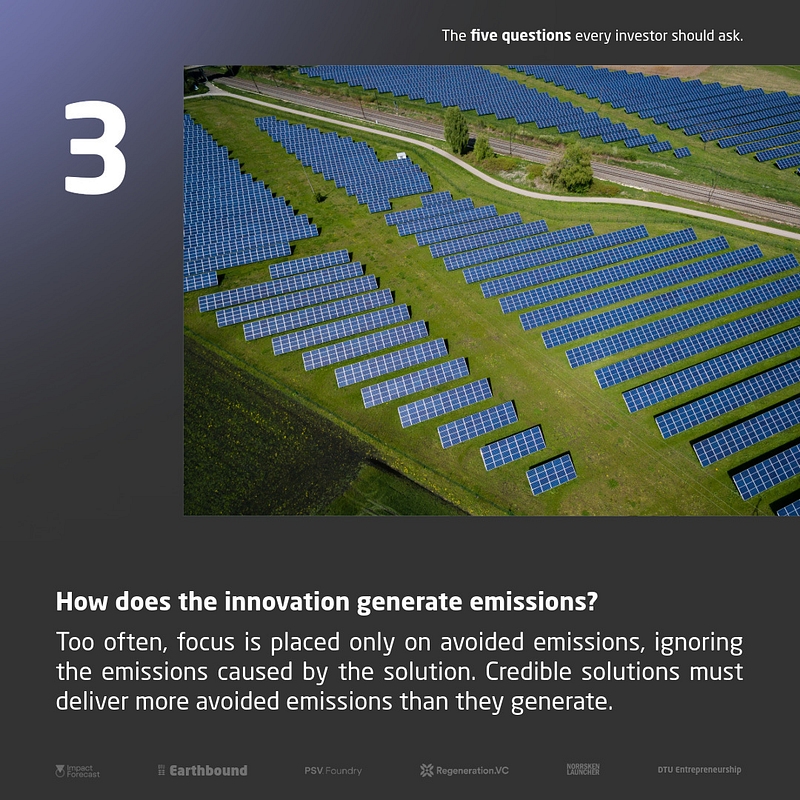
Too often, focus is placed only on avoided emissions, ignoring the emissions caused by the solution – both upstream and downstream.
- A soy burger or solar panel still has a carbon footprint.
- Some carbon removal technologies consume so much energy or material that their net benefit is questionable.
- Hydrogen often branded “zero-emission,” may have significant production emissions depending on its source.
Credible solutions must deliver more avoided emissions than they generate. Avoid “zero emissions” claims unless the system boundaries are clearly defined.
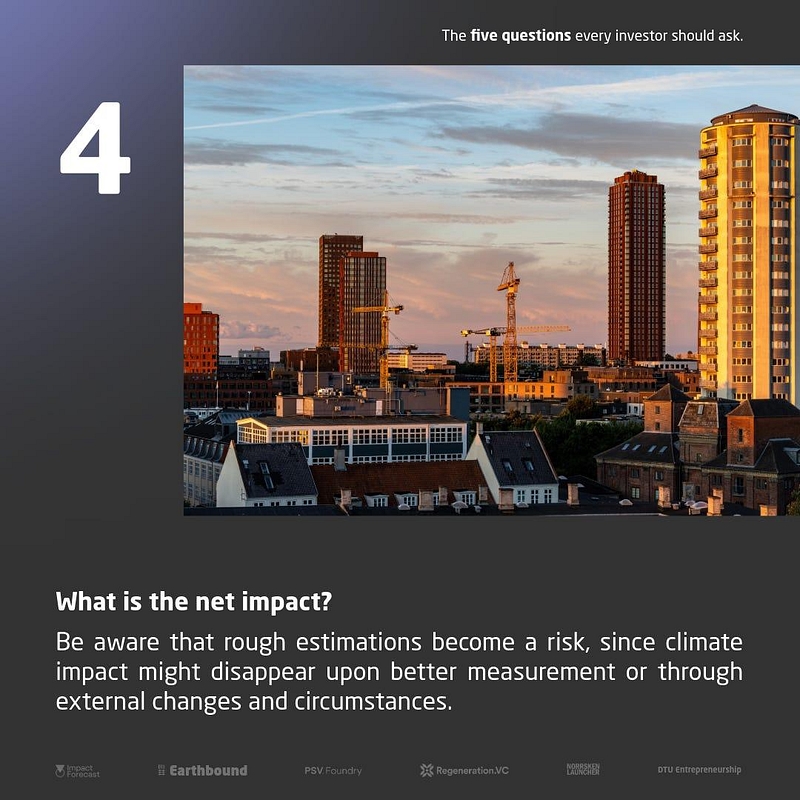
What is the Net Impact?
Now that we have a grasp on how an innovation avoids and creates emissions, it is important to know roughly how much. You don’t need a full LCA at the pre-seed stage and a 6000 Euro software tool. Rough estimations are sufficient because the range per innovation is much, much smaller than the range between innovations. But be clear on system boundaries and the assumptions.
In cases where the innovation emissions are less than the avoided emissions by a small margin, rough estimations do however, become a risk. When avoiding 10t and emitting 9t, the net reduction of 1t is very sensitive to the accuracy of 10 and 9. The risk in these cases is that the positive climate impact disappears upon better measurement or through external changes and circumstances. For climate impact business models that are not typical, innovation emissions are often orders of magnitude below the avoided emissions.
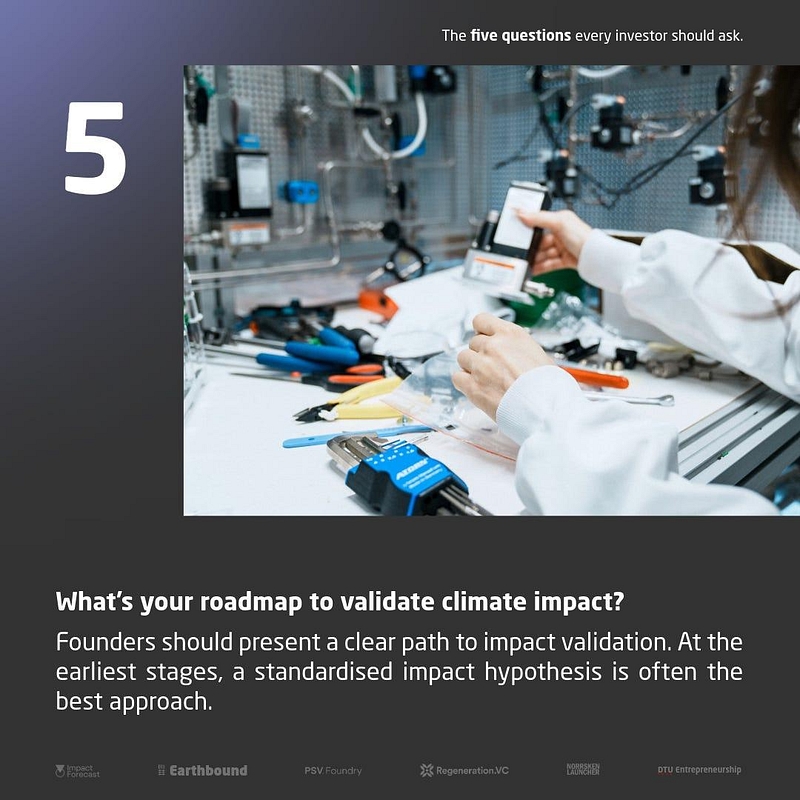
What’s your roadmap to validate climate impact?
Founders should present a clear path to impact validation, including plans for:
- Life Cycle Assessments (LCA)
- Third-party verification
- Environmental Product Declarations (EPDs)
- Alignment with frameworks like the EU Taxonomy
At the earliest stages, a standardised impact hypothesis is often the best approach. It enables startups to present credible estimates, and investors to compare impact potential across companies – without requiring unaffordable or irrelevant certifications too early.
Conclusion
The climate crisis leaves no room for wasted capital or false promises. If we’re to meet our climate goals, we all need to raise the bar for how we evaluate early-stage impact.
Embedding structured climate impact due diligence—rooted in clear and consistent questions—helps ensure that truly meaningful solutions are not missed. It improves funding outcomes, sharpens product development, and creates stronger, mission-aligned partnerships from day one.
To founders: Be ready to explain the problem you’re solving, your net impact potential, and your plan to validate that impact. Don't be discouraged if you don't have all the answers yet - aim for clarity and transparency, not perfection.
To investors: Ask the hard questions - also on impact —not to disqualify, but to uplift the innovations that matter most.
Climate innovation doesn’t start at scale. It starts here. And if we want to make a real difference in Europe, we need to get them market-ready - fast.
NB: While this article focuses on greenhouse gas (GHG) emissions - the single largest driver of climate change - we recognize that climate action is inseparable from broader environmental goals, especially biodiversity. More and more investors and startups are now integrating biodiversity considerations into their strategies, but for the purposes of this article, we focus on GHG emissions as the most direct and measurable climate impact.
Authors
Solvej Karlshøj Christiansen, DTU Earthbound
Camilla Møller Espersen, PSV Foundry
Bram van der Grinten, Impact Forecast
Laurens Van Dort, Impact Forecast
Francesco Rosati, DTU Entrepreneurship
Destana Herring, Regeneration VC
Emma Kjellander, Norrsken Launcher